



How Writing by Hand Improves Memory in the Age of Information Overload
And Why Journaling with Pen and Paper Frees Up the Information Superhighway in Your Head
The aging brain could use a serious boost as the digital age hurtles along. And as it turns out, so does the increasingly forgetful young brain. If forgetting is for the old, then aren’t we aging rather too fast? Perhaps we have become so dependent on our modern gadgets’ memory that we have taken for granted our own rather equally fragile and powerful human one. And yet in a time when we are bombarded with information, and options for storing information seem endless and ridiculously easily available, the ability to remember is, for all intents and purposes, even more important. Because you know what? Forgetting is easy. At least as far as 19th-century German psychologist Herman Ebbinghaus was concerned. Over a hundred years ago, Ebbinghaus conducted experiments on himself to understand how memory works. Then he plotted the graph that illustrated the rate at which something is forgotten after it is initially learned—the forgetting curve.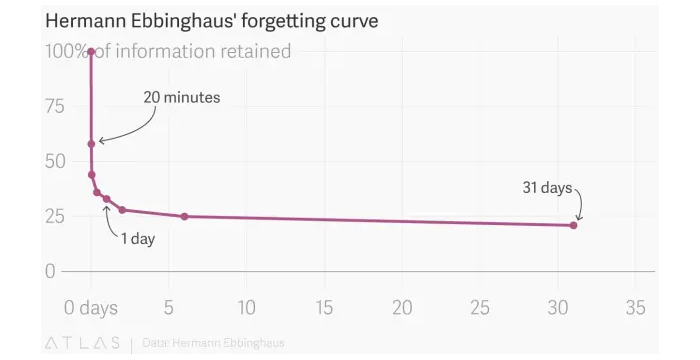 Ebbinghaus’s takeaways are as follows:
- We promptly forget what we learn within the first hour.
- We lose an average of 60% of the information we process within the first 20 minutes.
- We lose most of the information we take in within the first 8 hours, after which our memory eventually levels off.
What the hand does, the mind remembers. —Maria Montessori
| This is our second article in our series on the benefits of writing by hand. Come back soon for more! |